Team Definition How to Build a Real Team with Clear Roles and Shared Goals

Introduction: Why Team Definitions Matter More Than Ever
You know that feeling when everyone says "we’re a team," but nobody really agrees on what that means? Maybe a manager calls a group of five people a team, yet they work completely alone. Or your HR manual uses "team" and "group" like they’re the same thing. This kind of fuzzy thinking causes real problems.
Research from organizational psychology shows that when teams have unclear roles and goals, performance drops, and frustration rises. In fact, decades of studies have proven that a shared understanding of what a team actually is makes a huge difference in how well people work together.
So what is a team? It’s more than just a collection of people. A real team has members who depend on each other, share a common goal, and work together to get results.

Without that clear definition, your team might just be a group of individuals doing their own thing.
That’s why understanding the team definition matters so much in 2026. When you get clear on the meaning, you can also explore related ideas like another word for team that fits your culture, or learn synonyms of team player to describe the behaviors you want. Even something as simple as knowing whether to write team mates or teammates shows attention to detail that builds trust.
This guide will give you evidence-based definitions and practical frameworks to help you build better teams. You’ll learn what makes teams work, why language matters, and how to put these ideas into action starting today.
Ready to see how clearer definitions can transform your workplace? Try some quick, low-prep activities to boost collaboration and morale.
What is a Team? Defining the Core Concept
So what separates a real team from just a group of people? The answer comes down to three things: interdependence, shared goals, and mutual accountability.
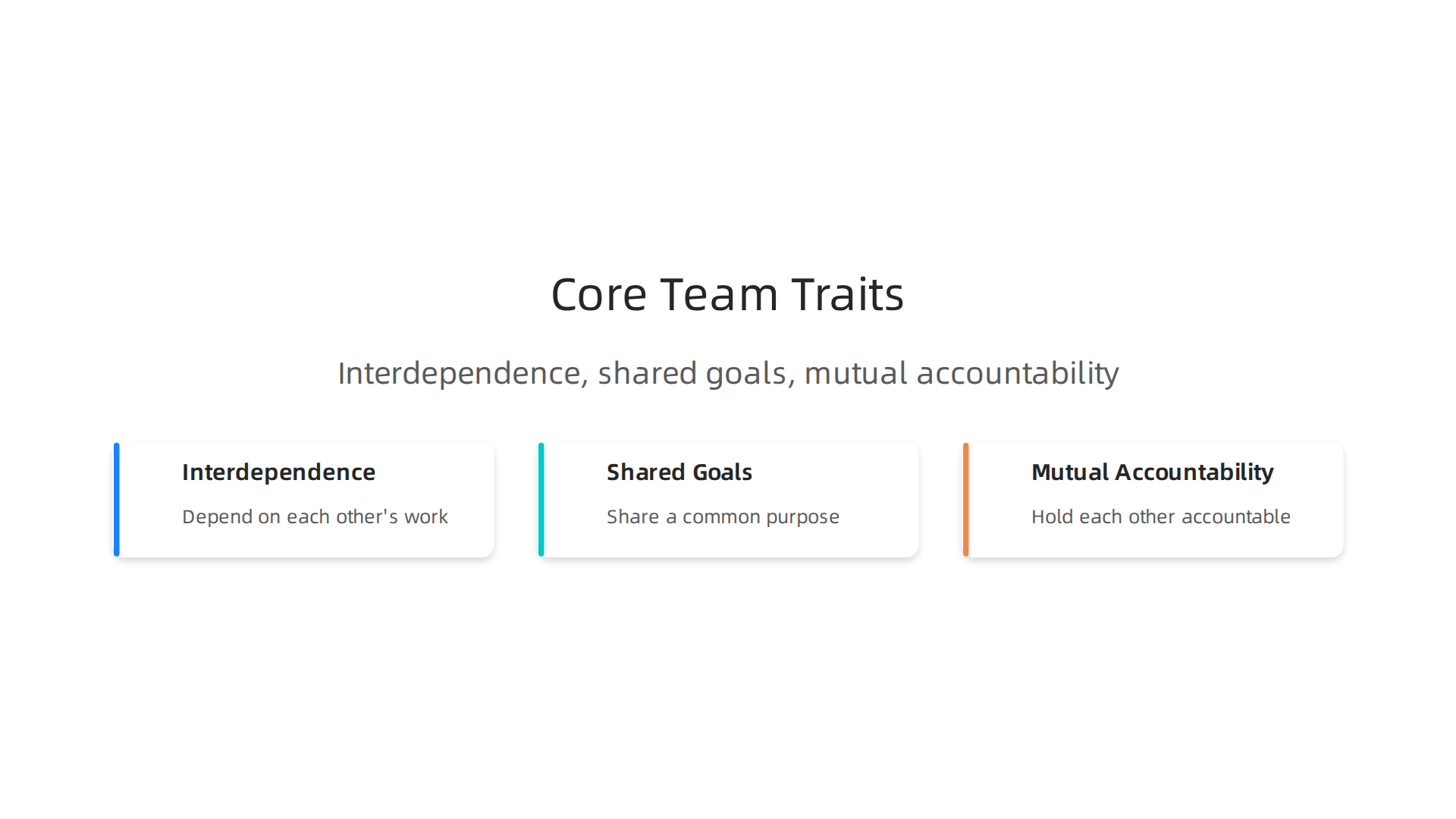
Organizational psychologists like Hackman (2002) and Katzenbach & Smith (1993) spent years studying this question. They found that real teams have members who rely on each other’s work, share a common purpose, and hold each other accountable for results. A group is different. It is just a collection of individuals working near each other without much real connection.
Marks and colleagues defined team processes as the "interdependent acts that convert inputs to outcomes" [source: Mathieu et al. 2017 PDF]. That word "interdependent" is the key. It means what you do directly affects what I do.
In 2026, the team definition needs to stretch further. Many teams now work across time zones and digital spaces. Researchers describe modern teams as "dynamic systems evolving in response to their environments" [source: Mathieu et al. 2019 PDF]. So a good definition today includes virtual coordination, async communication, and digital trust.
Language matters here too. You might search for another word for team that fits your culture better. Or explore synonyms of team player to describe the behaviors you want to encourage. Even the question of team mates or teammates shows you care about getting the small details right.
The bottom line? A team is a group of interdependent people working toward a shared result. If that sounds simple, try applying it. You might discover your "team" is really just a group that could use stronger connections.
Want a quick way to strengthen those connections? Try some fun online games for remote team building to boost collaboration. For even more ideas, explore our full list of quick team building activities.
Historical Evolution of Team Definitions
You might think the team definition has always been the same. But researchers have changed their view a lot over the last century.
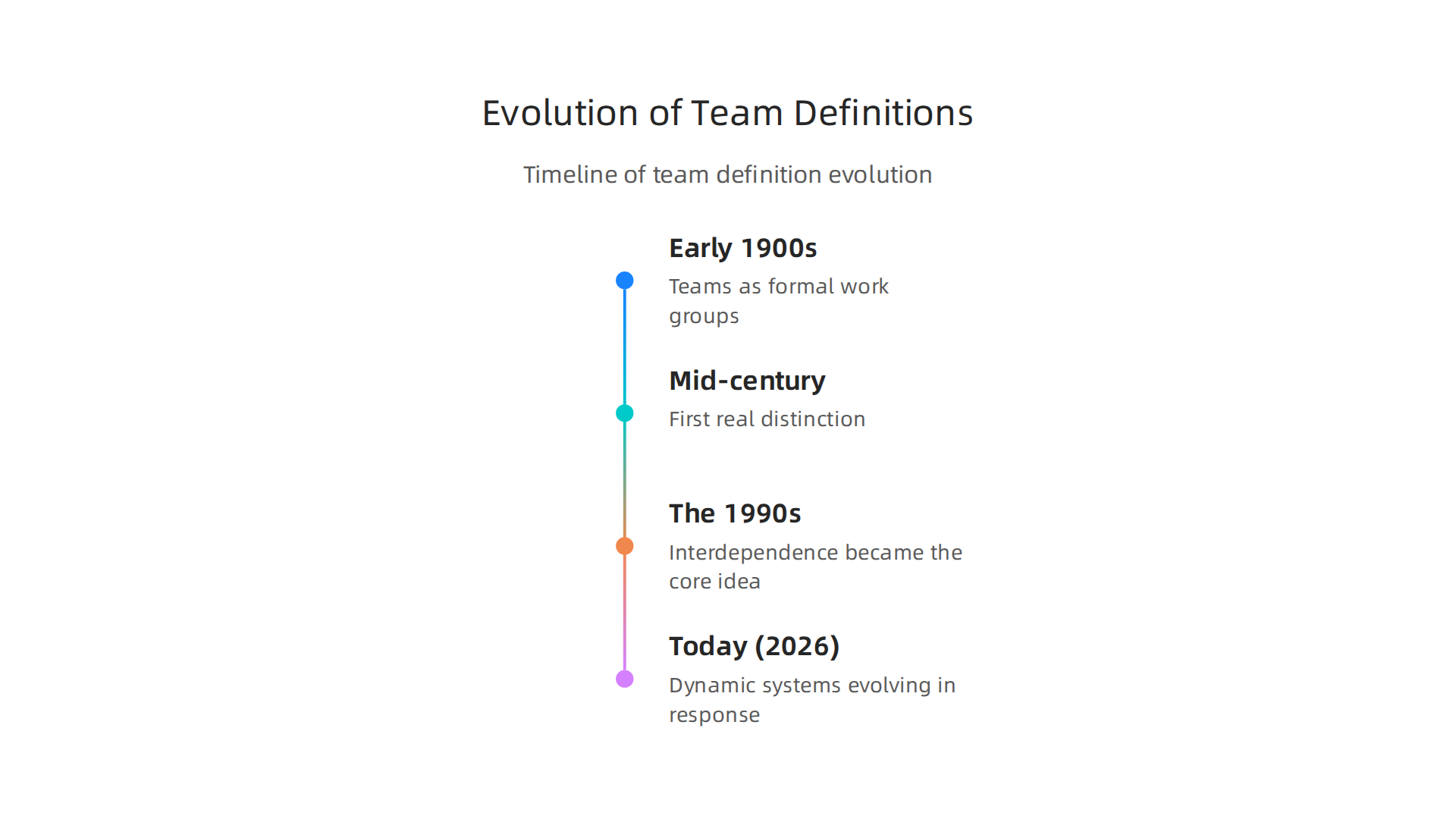
Early 1900s: Teams as formal work groups
Back in the early 1900s, researchers saw teams as simple work groups. The focus was on output and efficiency. Industrial and organizational psychology was just starting to study workplace behavior. Back then, the words "group" and "team" meant almost the same thing. There was no real distinction.
Mid-century: The first real distinction
Around the 1950s and 1960s, researchers began applying experimental psychology methods to teams. This was a major turning point. They started to see that a true team was different from a random group. A team had shared goals and required meaningful interaction between members. The modern team definition began to take shape here.
The 1990s: The big shift
The 1990s changed everything. Companies everywhere moved to team-based designs. This created a huge need for a clear definition. Researchers like Mathieu and colleagues defined team processes as "interdependent acts that convert inputs to outcomes." Interdependence became the core idea that separated a team from a group.
Today (2026): Dynamic and fluid
Now the definition has stretched even more. Researchers describe teams as "dynamic systems evolving in response to their environments." Modern definitions include diversity, technology, and flexible membership. A team might form, work together for a short project, and then dissolve. That is completely normal in 2026.
Understanding this history helps you see where your team might be stuck. If your team still behaves like a formal group from the 1950s, you might need a fresh approach. The best way to build a modern, interdependent team is through shared experiences. Try one of our free online escape rooms for a fun new challenge. Or explore our full collection of quick activities designed for today’s teams.

The Modern Team in Hybrid and Remote Work
Now let’s look at what the team definition means for today’s hybrid and remote teams. This is where the old rules really break down. When your team is spread across time zones and works asynchronously, you lose all those quick chats at the water cooler. You lose the informal signals that tell you who does what.
Here is the thing. A 2026 report from Gallup found that only 20% of employees worldwide were engaged at work. That costs the global economy a staggering amount. One major reason is role ambiguity. When people do not know exactly what their job is, they disconnect. Research from Effectory shows that employees with clear roles are 53% more efficient and 27% more effective than those without.
This makes the team definition matter more than ever. If your hybrid team still uses generic titles like "team member" or "another word for team" like "group," you are asking for confusion. You need explicit definitions. You need to know who the "synonyms of team player" actually are on your team. You need to know if someone is a "team mates or teammates" in the modern collaborative sense.
Best practices in 2026 include co-creating a team charter. Sit down together, remotely or in person, and write out exactly what each person owns. Then do regular role alignment check-ins. This builds the kind of interdependence the modern team definition requires.
Looking for a fun way to build that shared language with your remote teammates? Try a quick activity designed for distributed teams. You can play fun online games with friends to practice defining roles in a low stakes setting. Or for a deeper conversation starter, start reading a silly sci fi book that your whole team can laugh about together.
Key Roles Within a Team and Their Impact on Dynamics
You might think a team definition is just a list of names on a chart. But the real magic happens when you look closer at the specific roles people play.
Formal roles are the ones you see on an org chart. Think leader, facilitator, contributor. These roles give your team structure and accountability. When everyone knows who owns what, work flows better. Research from Effectory shows that employees with role clarity are 53% more efficient and 27% more effective than those without clear roles. That is a huge boost from simply knowing your job.
Informal roles are different. They emerge naturally without anyone assigning them. You probably already have a connector on your team who links people across departments. A critic who spots flaws before they become problems. A cheerleader who keeps morale high during tough weeks. These roles shape how your team really collaborates. A study on role clarity and job competence found that understanding these unwritten roles helps people take more initiative at work.
Here is the truth. When you mix clear formal roles with healthy informal roles, conflict drops. Team satisfaction goes up.

A good team definition goes beyond just another word for team like "group." It captures who does what and how people interact.
Want to build that shared understanding with your team? Try a structured activity. You can play fun online games with friends to see who naturally takes the facilitator or connector role in a low stakes setting.
Then take it a step further. Read Book 1 with your teammates as a funny conversation starter that helps you learn each other’s thinking styles.
The Formal Roles: Leader, Facilitator, Contributor
When you build your team definition, three formal roles deserve a spot.
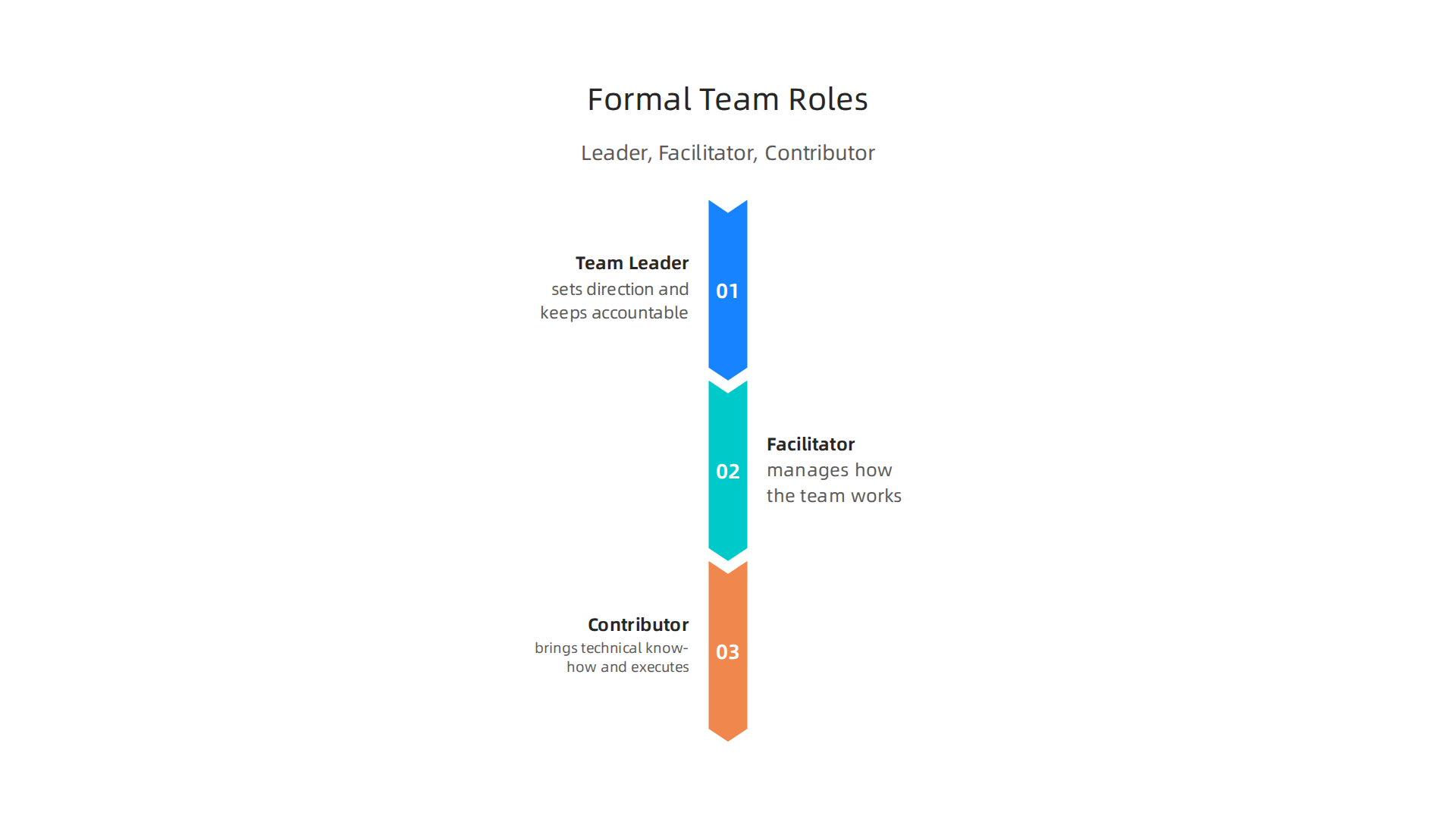
The team leader sets direction and keeps everyone accountable. They own the big picture. Without that, teams lose focus fast. Research on role clarity shows that people who know their role are 53% more efficient. That is a real boost from simple clarity.
The facilitator manages how the team works together. They keep meetings productive and make sure everyone has a voice. A good facilitator removes roadblocks so the team can focus on what matters.
The contributor brings the technical know-how and executes the work. These are the doers. They code, design, build, and solve problems. Their focus is getting things done.
When all three roles are clear in your team definition, confusion drops. People stop wondering who does what. Instead, they focus on doing their best work. Workplace collaboration statistics show that teams who collaborate well see higher productivity and engagement.
Want to spot these roles in your own team? Try a free online escape room game and watch who steps up as leader, facilitator, or contributor.
Then Explore Activities for more easy exercises that strengthen your team dynamics.
Informal Roles: The Connector, The Critic, The Cheerleader
Formal roles are important, but the real magic happens in the informal ones. These aren’t on any job title. They just show up naturally. And they make a huge difference in your team definition.
The Connector is the person who bridges communication gaps. They talk to people from different subgroups and make sure information flows. Without a connector, departments or remote teammates can feel isolated. This person keeps everyone in the loop. They are a great example of a synonym of team player because they put connection first.
The Critic challenges assumptions. They ask "why" and push back on ideas that seem weak. This role is vital for good decisions. Google’s Project Aristotle found that psychological safety is the top factor for high-performing teams. In a safe environment, teammates feel free to speak up and challenge ideas. That is exactly what a healthy critic does. Without them, teams get stuck in groupthink.
The Cheerleader boosts morale and celebrates wins. They notice when someone does a good job and say it out loud. This role keeps energy high. When teams feel appreciated, they work better together. It is another word for team spirit in action.
These informal roles are just as essential as the formal ones. To spot them in your own group, try a low-pressure activity. For example, a fun online game lets you see who naturally connects, who questions, and who cheers.
And if you want more ideas to strengthen these roles in your team, Explore Activities for quick exercises that build psychological safety and collaboration.
How Team Definitions Influence Culture and Performance
Now that we have looked at the informal roles that appear naturally, let us look at the foundation. How you define your team sets the stage for everything else.
If your team definition is fuzzy or means different things to different people, culture suffers. One person might see the team as just their immediate coworkers. Another might include the whole department. When these ideas clash, it creates confusion.
Google’s Project Aristotle taught us that high-performing teams have clear roles, plans, and goals.

Without a shared team definition, it is hard to build that clarity. This ambiguity leads to misaligned expectations and friction.
An explicit team definition acts like a map. It helps new team mates or teammates integrate faster because they understand the boundaries and the mission right away. This reduces the friction of "who does what." It is a key part of building psychological safety, where everyone feels safe to speak up. Clear definitions help everyone act on the synonyms of team player, like being reliable and collaborative.
When you get the definition right, performance improves. Everyone shares the same mental model. They know they are working toward the same goal. This is the real meaning behind another word for team: a group moving in the same direction with trust.
Want a fun way to test your team’s shared understanding? Try a free online escape room game with your group.
Explore Activities at Team Booster to find simple exercises that help your team build a shared definition and stronger bonds.
Aligning Terminology to Reduce Friction
You know that awkward moment when someone says "I need to check with my team lead" and another person responds "Wait, I thought Sarah was the manager?" This happens all the time. When you use "team lead" and "manager" as if they mean the same thing, confusion spreads fast.
These small language gaps create real friction. One person thinks a decision needs approval from the manager. Another assumes the team lead handles it. Tasks stall. Frustration builds. This is why a shared team definition matters more than you might think.
The fix is simple. Create a shared glossary for your team. Write down what each role means. Define key processes. Agree on what being a good team player looks like in practice. When everyone uses the same words the same way, the synonyms of team player start to show up naturally. People become more reliable and collaborative.
Google’s Project Aristotle research found that high-performing teams have clear roles, plans, and goals. Without that clarity, even the best team mates or teammates will struggle.
Want a low-pressure way to test your team’s shared understanding? Try a free online escape room game together. It is a fun way to spot alignment gaps.
Explore Activities at Team Booster to find simple exercises that help your team build a shared glossary and stronger bonds.
Case Studies in Role Clarity
So what happens when teams actually take role definition seriously? Real results show up fast. One tech startup cut their onboarding time by 30% after clearly defining each role. New hires knew exactly who to ask for approvals, who handled specific tasks, and where their own responsibilities ended. No more waiting for someone to figure out if the "team lead" or "manager" needed to sign off. That shared team definition saved weeks of confusion.
The impact is even bigger for distributed teams. When your teammates are spread across time zones, unclear roles create painful delays. A message sent at 9 AM might not get a reply until the next day if nobody knows who owns the decision. Research shows that managing cultural differences in global remote teams requires clear norms and psychological safety.

Without role clarity, even the most willing team mates or teammates end up stepping on each other’s toes.
Lessons from global companies are clear: defining roles isn’t just a nice to have. It is the foundation for speed, quality, and trust. When everyone knows their lane, the synonyms of team player like reliable, accountable, and collaborative become everyday behaviors.
Want to test your team’s role clarity in a low-pressure way? Try a quick team game like Boggle for remote teams. It reveals who naturally takes the lead and how roles form.
Explore Activities to find simple exercises that build shared team definitions and stronger collaboration.
The Psychology Behind Team Roles: Belonging and Identity
Why do some people fully own their role while others hold back? The answer lies in how we see ourselves as part of a group. Social Identity Theory says we get part of our self-worth from the groups we belong to. When someone feels they are a valued team mates or teammates, they commit more deeply to their responsibilities. A strong team definition helps people see exactly where they fit, which boosts their sense of belonging.

But belonging only works when people feel safe. Psychological safety is the foundation. Without it, no one will take risks or fully step into their role. Research shows that managing cultural differences in global remote teams requires clear norms and psychological safety. When a team leader defines roles with care, they signal that every person matters. That is when the synonyms of team player like reliable and collaborative come alive.
What is another word for team? It is a system of connected roles. Leaders who understand this psychology design roles that satisfy the need for identity and safety. The result is higher motivation and lower turnover.
You can test this dynamic with a light activity. Try a fun online game with friends that lets roles emerge naturally. Watch how people claim their space.
Start Reading a ridiculously fun story that your team can laugh about together and build shared identity.
Social Identity Theory Applied to Teams
Think about your favorite sports team. Every player knows their position. That clarity makes them play harder and feel proud of their spot. The same idea works for any group at work.
People naturally sort themselves into groups. It is how we make sense of the world. When you give someone a clear team definition, you help them see exactly where they belong. That simple act strengthens their identity within the group. They feel like a valued set of team mates or teammates rather than just another face in a meeting.
Here is the thing. When roles are fuzzy, identity gets shaky. Role ambiguity happens when someone does not know what they are supposed to do. This confusion makes people pull back and disengage. It is a real problem, especially in remote teams where communication is thinner. Research from Harvard shows that managing virtual teams comes with unique challenges like unclear roles and expectations. When you leave roles vague, you leave identity hanging.
Leaders can fix this by naming roles with care. Instead of saying "you handle this part," say "you are the reliability anchor for this project." Use labels that connect to purpose. That turns a generic role into a badge of honor. It also brings out the synonyms of team player like dependable and collaborative.
A quick way to test this at your next meeting? Try an activity where roles naturally bubble up. For example, run a free online escape room game for team building and watch who leads, who organizes, and who keeps the mood light. Then use those insights to name clearer roles for your next project.
Explore Activities that help your team discover and own their roles without heavy planning.
Psychological Safety as a Foundation
A clear role means nothing if people are too scared to fill it. Psychological safety fixes that. When your team mates or teammates know they can speak up without punishment, they step into informal roles like critic or connector. But vague roles kill that courage. Nobody wants to challenge a bad idea if they are not sure it is allowed.
Safety makes the team definition stick. It turns "another word for team" from a group into a place where every voice belongs. A team charter that explicitly values different contributions does exactly that. It tells people that being a dissenter or a cheerleader is part of the role. That is where synonyms of team player like honest and brave start showing up.
How do you measure safety? A simple team health assessment can reveal weak spots. Tools like the Gallup Q12, covered in 9 team health check methods, ask if people feel safe to be themselves. If the answer is no, it is time to act.
Even light activities help. A game like Boggle online team building for remote teams gets people laughing together with no risk. That builds the habit of honest expression.
Explore Activities that create safety without heavy planning.
Practical Frameworks for Defining Your Team
You have a group of people, but do they know exactly what each person does? If not, you are missing a strong team definition. A team charter is a one page document that fixes this. It lays out your purpose, roles, norms, and goals in a simple, shared space. Think of it as the rulebook that turns "another word for team" into a clear, working machine.
Start by writing down the team’s mission. Then list every role, even the informal ones. Who is the critic? Who is the connector? Calling out these roles makes synonyms of team player like "diplomat" or "driver" visible to everyone. Next, set norms. These are the behaviors everyone agrees to follow, like "we speak up early" or "we respect quiet time." Tools like the Gallup Q12, part of 9 team health check methods, ask if people know what is expected of them. That is the foundation.
Templates for role clarity help you adapt this to any team size. A three person startup and a twenty person department can both use a charter. The secret is keeping it short. One page max.
Finally, review your charter every quarter. Projects change. People grow. Your roles should shift too. A quick activity like Boggle online team building for remote teams can serve as a light check in where team mates or teammates share updates in a fun way.
Need help finding the right activities to keep your charter alive? Explore Activities that make role reviews easy and enjoyable.
The Team Charter Approach
A team definition works best when everyone helps write it. Co-creating your charter builds true buy-in. People follow rules they helped shape.
Every good charter has the same core sections:
- Mission: Why your team exists.
- Roles: Go beyond job titles. Make synonyms of team player like "connector" or "driver" visible to everyone.
- Meeting Norms: How you respect each other’s time.
- Decision-Making: How you break ties or choose a direction.
- Conflict Resolution: The first step when team mates or teammates disagree.
Getting this clarity pays off fast. One marketing team improved project delivery speed by 25% after adopting a simple charter. Regular team health assessments can help you track if your charter is still working for the group.
Review your charter every quarter. People grow, and roles should shift too. A fun way to check in is through a quick game. Try a round of Boggle online team building to see how your team communicates under playful pressure.
Want to start the conversation in a different way? Start Reading a light, silly story that gets everyone laughing and sharing new perspectives.
Role Clarity Tools and Templates
A written charter gives you the big picture. But how do you make sure each person knows exactly what they do every day? That is where role clarity tools come in. Think of them as the instruction manual for your team definition.
The most popular tool is the RACI matrix. RACI stands for Responsible, Accountable, Consulted, and Informed. For every task or decision, you assign one of these four labels to each team member. This stops the dreaded "I thought you were doing that" conversation. It is a simple way to clarify another word for team accountability.
You can also use skill matrices to map what each person is good at. This helps you spot gaps and celebrate strengths. When team mates or teammates see their unique skills valued, engagement goes up. Recent team management trends in 2026 show that aligning roles with personal strengths is a top driver of retention.
Many teams now use digital tools to build these templates. Miro has pre-built RACI boards. Trello lets you create responsibility lists on cards. These platforms make it easy to update roles as your team changes. The 2026 Global Human Capital Trends report from Deloitte notes that flexible, clear role structures are key for adapting to today’s hybrid work reality.
Want to see which synonyms of team player show up naturally in your group? A quick fun online game to play with friends for remote team building can reveal who naturally takes on connector or driver roles.
Ready to build your first role clarity tool and make your team definition crystal clear? Explore Activities for simple templates you can start using today.
Summary
This article explains why a clear team definition matters and how to turn a loose group of people into a high-performing team. It defines a team by interdependence, shared goals, and mutual accountability, and traces how that definition has evolved to include hybrid, remote, and dynamic work in 2026. The guide describes formal roles (leader, facilitator, contributor) and informal roles (connector, critic, cheerleader), and shows how role clarity improves culture, psychological safety, and productivity. Practical frameworks include a one-page team charter, RACI and skill matrices, and regular role-checks; the piece also recommends low-prep activities and games to reveal natural roles. Readers will learn concrete steps to draft a charter, align terminology, reduce friction, and run quick exercises that strengthen collaboration and accountability. By the end, you’ll be able to audit your current