Another Name for Team That Changes How Your Group Works Together

Introduction: The Words We Use Shape How We Work
Think about the last time you called your group a "team." Did it feel like one? Here’s the thing. The word "team" gets thrown around a lot in 2026, but not every group of people working together actually acts like a real team. And the words we choose to describe each other matter more than you might think.
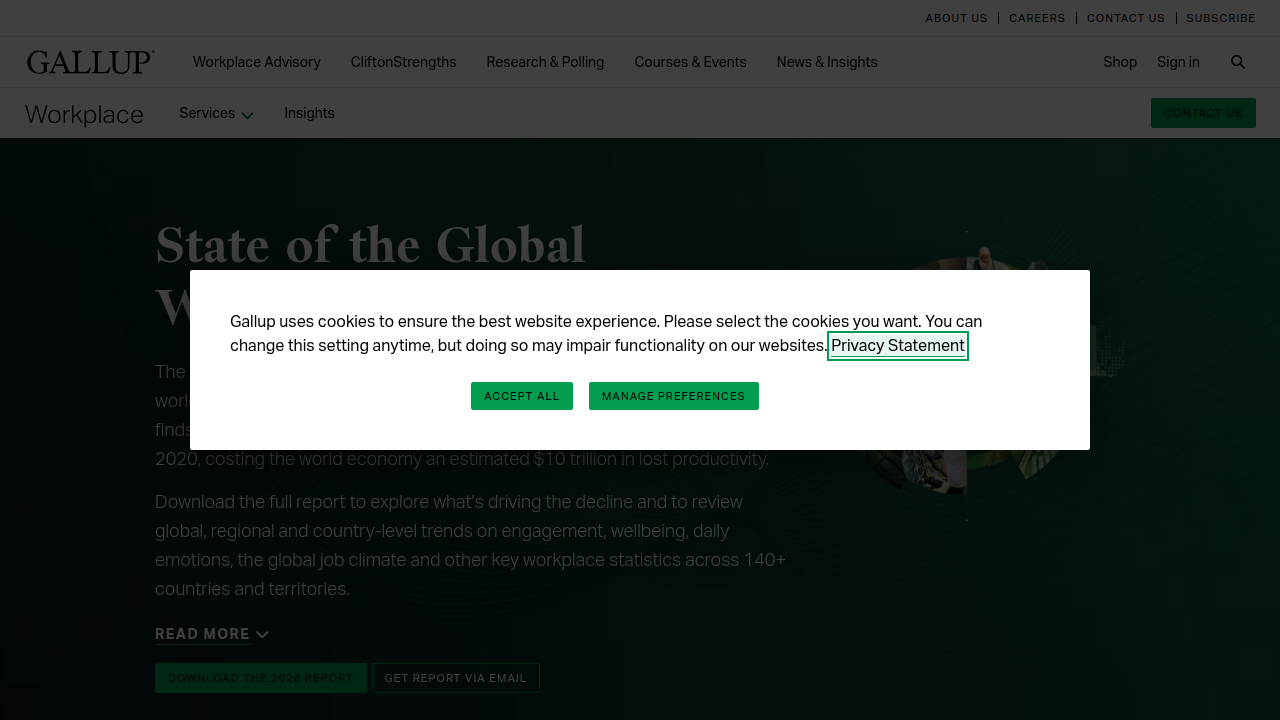
Research shows that only 20% of employees worldwide were engaged in their work in 2025, costing the global economy a staggering $10 trillion in lost productivity according to Gallup’s 2026 State of the Global Workplace report.
That is a huge problem. And part of it comes down to how we talk about collaboration.
When you use the wrong label for your group, you set the wrong expectations. Calling a loose collection of individuals a "team" when they really function as a "group" or a "crew" can lead to confusion.

People might expect shared accountability, deep trust, and joint problem-solving. But if the structure does not support that, frustration builds.
So what is the another name for team that fits your situation? The English language gives us many options. Words like alliance, squad, crew, partnership, and coalition all describe different flavors of working together. Even team antonyms like "individual contributor" or "solo operator" help clarify what you are not. Understanding these differences helps you lead better and communicate clearly.
Poor communication quietly drains more money from companies than most teams realize. It slows down projects and creates duplicate work according to Zoom’s 2026 workplace communication statistics. Using precise language is one small but powerful fix.
This article gives you a clear framework for understanding group vocabulary and how it affects your team dynamics. You will learn practical alternatives to the word "team," when to use each one, and how the right name can improve collaboration. We will also explore leadership team building activities that match each group type and team building activities strengths that help you pick the right approach.
If you want to build stronger connections with your people, start by getting the words right. Then pair that language with the right activities. Check out our guide on team definition and how to build a real team with clear roles and shared goals to take the next step.
Ready to find the perfect word for your people? Let us dive in.
Beyond ‘Team’: The Lexicon of Collaboration
So you want another name for team that actually fits your group. Good call. English gives us a rich toolbox of words, and each one carries a different flavor.
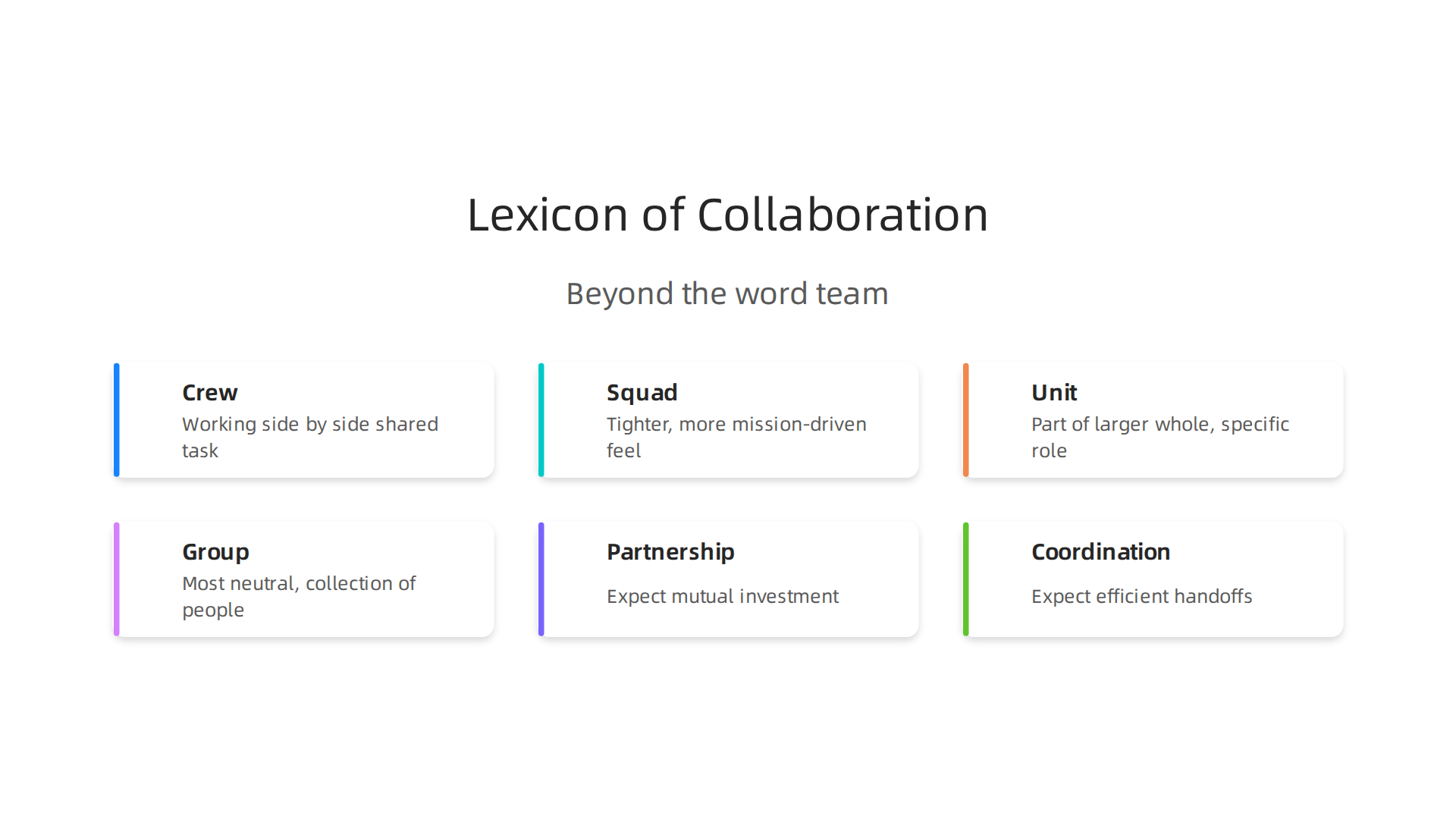
Think about the word "crew." It feels different than "team," right? Crew suggests a group working side by side on a shared task, like a film crew or a construction crew. There is a sense of hands-on work and practical coordination. According to WordHippo’s list of synonyms, crew sits alongside words like squad, unit, and organization.
Then there is "squad." This one has a tighter, more mission-driven feel. Squads often work in smaller numbers with a clear goal and strong loyalty. Military units and sports teams use this word. It signals a higher level of trust and shared responsibility.
"Unit" points to structure. A unit is part of a larger whole, and everyone knows their specific role. This word works well for departments or functional groups where precision matters more than personal bonding.
"Group" is the most neutral option. It simply describes a collection of people. Sometimes that is exactly what you need. Not every collection of individuals is trying to be a close knit team. Calling them a group sets honest expectations.
Here is where it gets practical. When you use precise terminology, you build better role clarity and psychological safety. A Merriam-Webster thesaurus entry for teamwork shows related words like collaboration, partnership, and cooperation. Each one carries a different weight. If your people hear "partnership," they expect mutual investment. If they hear "coordination," they expect efficient handoffs.
A shared vocabulary prevents misunderstandings. Imagine telling your remote workers they are a "squad" when they really function as separate individual contributors. They might expect shared decision making and deep interdependence. But your structure does not support that. Frustration builds fast.
On the flip side, calling a tightly knit group a "committee" feels cold and bureaucratic. It can kill the energy you are trying to build.
The same logic applies to team antonyms. Words like "solo operator" or "individual contributor" help clarify what your group is not. This clarity is especially important when you plan activities for your people. The right name helps you choose the right approach. For example, a "crew" might benefit from hands on problem solving challenges, while a "squad" might thrive on mission based exercises like free online escape room games.
Start by picking the word that matches your group’s actual structure and goals. Then use that word consistently. You will be surprised how much smoother communication becomes.
The Psychology Behind Group Language
So we just talked about picking the right word for your group. Crew, squad, unit. But does it actually matter that much? Yes, it really does. The name you use shapes how people see themselves and each other.
Here is the core idea. Social identity theory says that we define ourselves partly by the groups we belong to. When you feel part of a group, that group becomes part of who you are.
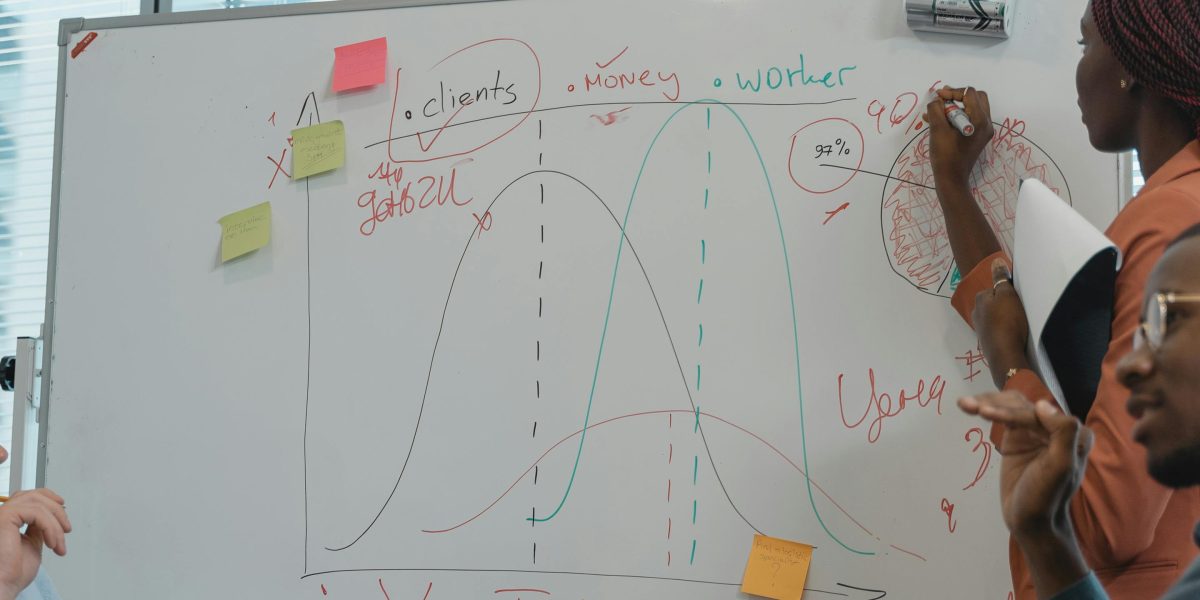
Research shows that when team members strongly identify with their group, their actual performance improves. A study in the journal Frontiers in Psychology found that team-level identification predicts both perceived and actual team performance. That is a big deal. The stronger the identity, the better the group works together.
Think about how this plays out. If you call your group a "squad," people start acting like a squad. They feel more loyalty, more trust, more shared responsibility. They see themselves as an in-group. And once that in-group feeling kicks in, people naturally cooperate more and defend their group against outsiders. That is not a bad thing, as long as the group is working toward healthy goals.
On the other hand, if you use a weak or vague label like "committee" or "task force," the identity is weaker. People see the group as temporary or bureaucratic. They do not feel the same bond. A study from the University of Sussex looked at amateur sports teams and found that the motives behind group identity directly predicted how strong that identity became. When people felt a sense of shared purpose and belonging, their group identity grew stronger. That same effect works in workplace teams too.
So how do you build that strong identity? First, pick a name that fits your group’s real purpose. Second, use that name consistently. Third, back it up with actions and language that reinforce the identity. For example, you can run activities that highlight the unique strengths of your group. That is where team building activities strengths come in. When your team has a clear identity, exercises like problem-solving challenges or free online escape room games become more meaningful. People are not just playing a game. They are strengthening their bond as a "crew" or "squad."
Here is the practical part. You should avoid calling everyone a "team" if they are really just a loose group of individual contributors. That sets the wrong expectation. Use team antonyms like "solo operators" or "independent contributors" when that is the truth. Clarity prevents frustration.
For leaders, understanding this connection between language and identity is a powerful tool. When you choose your words carefully, you are not just labeling a group. You are shaping how they feel about each other and their work. That is the kind of small change that can transform a struggling group into a high performing one. If you want to dig deeper into how to apply this, check out our guide on team definition and how to build a real team with clear roles and shared goals.
The bottom line? The word you pick is the first step toward the identity you want to create. Choose wisely.
Mapping Team Dynamics: From Forming to Performing
Okay, so we just talked about how the label you choose shapes your group’s identity. But labels alone are not enough. Why? Because groups grow and change over time. A brand new group of coworkers is not the same as a battle tested crew. The language and names you use should change too.
That is where Tuckman’s model comes in. It is a simple but powerful framework that shows how groups move through stages. Forming, Storming, Norming, Performing, and Adjourning.
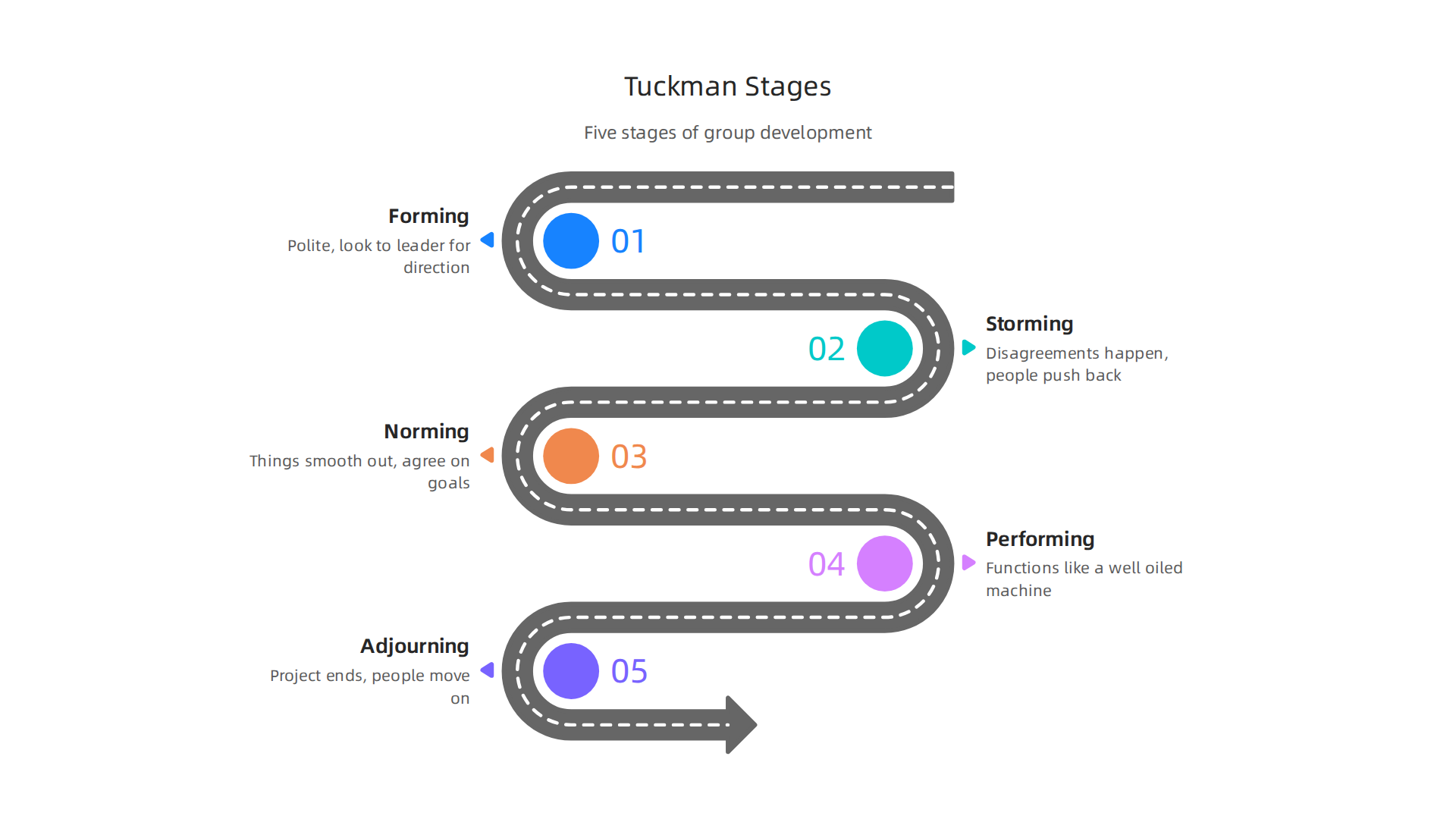
Understanding these stages helps you pick the right word and the right action at the right time.
Stage 1: Forming
Everything is polite. People are quiet. They look to the leader for direction. At this stage, calling them a "squad" might feel forced. They are still a "group" or a "new team". Your job is to provide structure. Use clear language. Run simple icebreakers to help people start connecting. This is where you plant the seeds for a strong identity later. You can explore how strong identity forms by watching this short video on Social Identity Theory.
Stage 2: Storming
Ah, the hard part. Disagreements happen. People push back. Trust is low. This stage is the real test. Many teams get stuck here. Your language needs to be calm and inclusive. Focus on listening. If you search for "team antonyms", this is where you might feel like a "group of rivals" instead of a team. Do not panic. This is normal. Use "leadership team building activities" to guide the group through conflict. Structured problem solving helps people find common ground. A fun shared challenge, like trying one of the free online escape room games for team building, can shift the energy from conflict to collaboration.
Stage 3: Norming
Things start to smooth out. People agree on goals. They start using "we" more than "me". Trust builds. Now you can start using labels like "crew" or "unit". The group feels more cohesive. Your language should shift to collaboration. This is a great time to run activities that highlight your group’s specific "team building activities strengths". Everyone is ready to work together.
Stage 4: Performing
This is the sweet spot. The group functions like a well oiled machine. They anticipate each other’s needs. They communicate easily. They have earned the right to be called a "team" or "power squad". Your language should be empowering. You step back. They lead themselves. Research from Frontiers in Psychology shows that strong team identity actually boosts performance at this stage.
Stage 5: Adjourning
The project ends. People move on. Celebrate the journey. Use language that honors the work done. Calling them a "project team" or "former crew" is honest and respectful.
The key insight here is that a single label does not fit every moment. If your "squad" is stuck in Storming, they need help, not just a new name. That is where the right activity can save the day. For example, if your team needs to rebuild connections, try something light like our list of fun online games to play with friends for remote team building. These games help people relax and remember they are on the same side.
Leaders who understand Tuckman’s model know when to push and when to pull. They adjust their vocabulary to match the stage. That is the smartest way to turn a random "another name for team" into a real, high performing unit. Check out our guide on team definition and how to build a real team with clear roles and shared goals to solidify your understanding of what makes a group truly click.
The Impact of Remote and Hybrid Work on Team Vocabulary
We just covered how teams move through stages and why the right label matters at the right time. But here is the thing: the way your team works has changed dramatically. In 2026, more than 52% of the global workforce operates remotely or in a hybrid model, according to Yomly. That is a huge shift. And it changes the very words your team uses to function.
New Jargon: Async, Digital Presence, and Virtual Collaboration
Remote and hybrid teams have developed their own vocabulary. Words like "async" (short for asynchronous), "digital presence" (how visible you are online), and "virtual water cooler" are now everyday terms. This is not just slang. It is a survival tool. When people cannot tap each other on the shoulder, they need precise language to coordinate. A report from Splashtop highlights that teams in 2026 rely on intentional communication rituals to stay aligned. That means the words you choose matter more than ever.
The Absence of Nonverbal Cues Makes Language Critical
Think about this: in person, you see a nod, a frown, a shrug. Those signals fill in gaps. But on a video call or in a Slack message, they are gone. So if you call your group a "crew" but someone interprets it as a "clique," you have a problem. Without body language, every word carries extra weight. This is why misalignment in vocabulary is a leading cause of friction in distributed teams. When people search for "another name for team" to describe their group, they are really looking for a word that fits their exact situation and culture.
To avoid confusion, leaders need to be explicit. Define your terms early. For example, explain what you mean by "team" versus "project group" versus "squad." And check in regularly to make sure everyone is on the same page. A shared vocabulary creates psychological safety, which the Owl Labs guide to remote work in 2026 calls a core foundation for high performance.
Misalignment Causes Friction
When team members use different words for the same concept, frustration builds. One person says "we need a sync" while another hears "we are meeting right now." That mismatch slows everything down. It is like speaking two languages in the same conversation. The Naboo team trends report for 2026 emphasizes that inclusion by design includes language. If you want everyone to feel like they belong, you need to agree on the words you use together.
Here is a practical step: start a shared glossary for your team. Write down key terms like "another name for team," "team antonyms," and any local jargon you invent. This helps new members catch up fast. And it reduces the friction that kills momentum.
The leaders who succeed in 2026 are the ones who adapt their vocabulary to the reality of remote and hybrid work. They do not just pick a label and stick with it. They update their language to match both the team stage and the work environment. If you want to strengthen your team’s connection, try a structured activity that builds shared language, like the ones in our guide on fun online games to play with friends for remote team building. These games help people relax and create a common experience, which naturally aligns how they speak to each other.
Your team may be scattered across time zones, but your vocabulary can still bring them together.

Start by being intentional with every word you choose.
Building a Shared Vocabulary for Better Collaboration
You know that feeling when someone says something and you nod along, but later you realize you both meant totally different things? That happens way too often in remote teams. And in 2026, with 52% of the global workforce working remotely or hybrid, those misunderstandings cost time, trust, and momentum.
The fix is simpler than you might think. You need a shared vocabulary. Not a corporate dictionary full of buzzwords. Just a clear, honest list of what your team means when they say certain things.
Start a Team Glossary
This is the single most effective step you can take. A team glossary is just a living document where everyone writes down key terms and their preferred alternatives. Think of it like a translation guide for your team culture.
For example, if someone asks for "another name for team" because the word "team" feels too formal for their squad, you can agree on a substitute. Maybe you call it a "crew" or a "pod" or an "alliance." The point is to decide together and write it down.
The Atlan guide to building a business glossary recommends starting small.
Pick the five terms that cause the most confusion in your group. Define them clearly. Then add more over time. This keeps the process manageable and ensures everyone can actually use it.
Create a Simple Structure
Here is a template you can copy today:
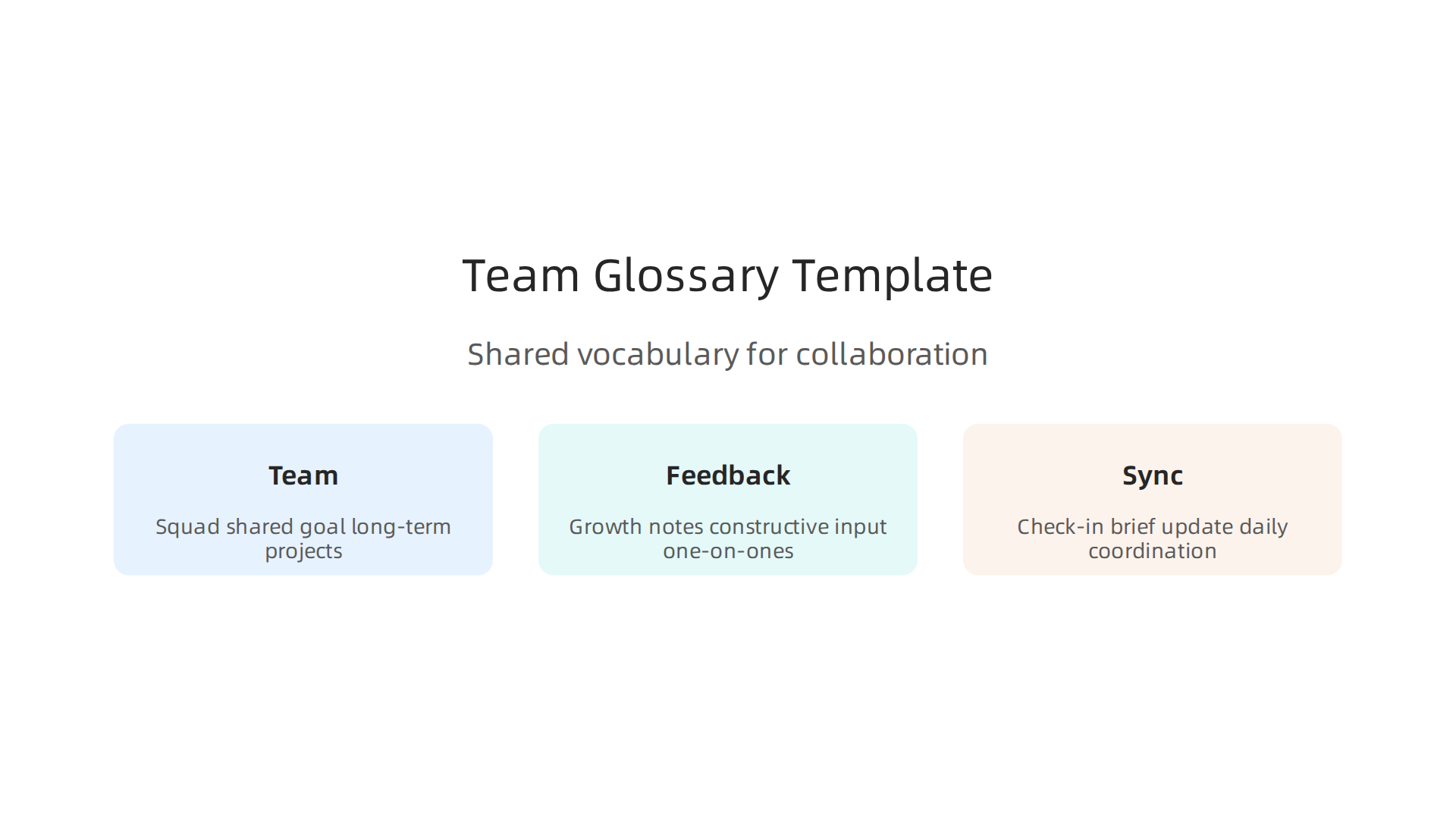
| Term | Preferred Alternative | What It Means | When To Use It |
|---|---|---|---|
| Team | Squad | A group working toward a shared goal | For long term projects |
| Feedback | Growth notes | Constructive input to help someone improve | During one-on-ones |
| Sync | Check-in | A brief update, not a full meeting | For daily coordination |
This format works because it gives people choices. They can pick the word that fits the moment. And it reduces friction because everyone knows the rules.
Check In on Language Regularly
A glossary is useless if you create it and never look at it again. Schedule a short check-in every month or quarter. Ask your team two questions:
- Are there any new terms we need to add?
- Is anyone confused about the words we use?
The Naboo team trends report for 2026 highlights that inclusion by design includes language. When you regularly revisit your shared vocabulary, you signal that everyone’s voice matters. This builds psychological safety and reduces the friction that kills remote collaboration.
These check-ins can be short. Just 10 minutes during a team meeting. You can even turn them into a quick game using our collection of free online games to play with friends that build stronger remote teams. Games naturally create shared experiences, and shared experiences create shared language.
Let the Team Own the Names
Here is a pro tip: do not decide on your team vocabulary alone. Involve everyone. When people help choose the words, they take ownership. They feel like the label belongs to them, not just management.
For example, if you are wondering about "team antonyms" or "team building activities strengths," ask your team directly. Run a quick poll. Let them vote on the top three alternatives. This small act of inclusion has a big impact on engagement.
And when you combine shared vocabulary with structured team exercises, the results multiply. That is why we created leadership team building activities that help teams practice using the words they have chosen. These activities turn abstract concepts into real habits.
The Bottom Line
A shared vocabulary is not a nice to have. It is a practical tool that makes remote teams run smoother. It reduces confusion. It builds trust. And it gives everyone a common foundation to work from.
Start your team glossary this week. Keep it simple. Check in often. And let your team own the words they use every day. You will be surprised how much clearer everything becomes.
Measuring Team Health Through Language
You have built your team glossary. Everyone agreed on a shared vocabulary. But here is the real question. How do you know it is working?
The words your team uses every day tell a bigger story than you might think. In fact, the way people talk in meetings, in chat channels, and in emails can reveal a lot about team health. It shows whether people feel safe, whether they trust each other, and whether they are really collaborating or just going through the motions.
This is not guesswork. In 2026, more teams are using linguistic analysis to measure cohesion and catch conflicts early. The 2026 State of Employee Listening report from Perceptyx shows that leading organizations now treat communication patterns as a key indicator of team health. And the numbers back it up. Gallup’s 2026 report found that only 20% of employees worldwide were engaged in 2025, costing the global economy $10 trillion in lost productivity. That is a massive signal that something is broken in how teams talk.
What Your Team’s Language Is Telling You
Here is the thing. You already have the data. Every Slack message, every email, every video call transcript is a clue. The trick is learning to read it.
Look for patterns like these:
- Do people use "we" or "I" more often? Frequent "we" language signals cohesion and shared ownership.
- Are team members comfortable asking questions? A high number of clarifying questions shows psychological safety.
- Do you see lots of apologies or hedging? Phrases like "sorry to bother you" or "just a thought" might indicate low safety.
- Is there a mix of formal and casual language? Too much formality can mean people are holding back.
These small signals add up. They tell you if your shared vocabulary is actually being used or if it is just a document nobody reads.
Use Surveys to Get Real Numbers
You cannot manage what you do not measure. That is why regular pulse surveys are so important. They give you quantifiable metrics on team health.
Ask questions like these:
- "Do you feel comfortable using our team’s preferred terms?"
- "Has our shared vocabulary made communication clearer?"
- "Do you feel safe sharing honest feedback?"
The 2026 Performance Management Report from The Talent Strategy Group found that companies using regular language and culture check-ins saw higher retention and better collaboration. When you pair surveys with the team building activities strengths you use, you get a complete picture of how your team is really doing.
The Articulate guide to employee performance metrics in 2026 recommends tracking at least three communication health metrics per quarter. Keep it simple. Pick one metric for clarity, one for inclusion, and one for collaboration.
Track Vocabulary Adoption Over Time
Here is where the real magic happens. Once you have your team glossary, you can track how well people are using it. This is a direct measure of team development.
Watch for these signs of progress:
- New hires start using preferred terms within their first week.
- Team members correct each other gently when someone uses an old term.
- The glossary grows because people suggest new terms.
- Conflicts decrease because everyone means the same thing when they speak.
When you see these signs, you know your shared vocabulary is becoming part of your team culture. That is when you start seeing real improvements in collaboration and trust.
And if you notice people are not using the glossary, do not panic. That is useful information too. It tells you the words you chose are not sticking. Maybe you need a different approach. Maybe you need to run a quick game or activity to reinforce the terms. That is where leadership team building activities can help turn abstract words into real habits.
The Bottom Line on Language and Health
Your team’s language is a living dashboard. It shows you exactly where things are working and where they are breaking. By measuring what people say and how they say it, you get early warnings about friction, disengagement, and hidden conflict.
The best part is that you do not need fancy tools to start. You just need curiosity and a commitment to listen. Start paying attention this week. Look at the words your team uses. Ask them how the glossary is working. Run a quick survey. The answers will tell you more than any spreadsheet ever could.
And if you want to accelerate the process, try combining your language health check with a structured activity. The combination of clear words and shared experiences is hard to beat.
Summary
This article explains why the words you use to describe groups—team, crew, squad, unit, or even ‘individual contributor’—shape how people behave, feel, and perform. It maps practical alternatives to