How to Build a Team Charter That Boosts Alignment and Trust

You know that feeling when your team is working hard but things just feel off? Meetings drag on. Tasks get duplicated. No one is sure who owns what. That lack of clarity drains energy and slows everything down. Without a shared roadmap, even talented groups struggle with unclear roles, misaligned goals, and fragmented communication.

That is where a team charter comes in. Think of it as your team’s north star document. It spells out your purpose, expectations, and how you will work together. According to the Center for Creative Leadership, a team charter simply defines how your team will operate and what each person’s role is. It turns fuzzy hopes into clear agreements.
Research backs this up. Gallup found that the best hybrid teams create a team charter to define how they work together, separate from company policy. That small step makes a big difference in alignment and trust.
This guide gives you research-backed steps to create a charter that boosts cohesion and productivity. You will learn exactly what to include, how to get buy in from your group, and common mistakes to avoid. For more on what makes a real team tick, check out this overview on how to build a team with clear roles and shared goals.
Once your charter is in place, keep the momentum going with a shared laugh. Check out a ridiculously fun sci-fi read that your team can bond over. It is a simple way to boost morale and reinforce the connections you built in your charter.
What Is a Team Charter and Why Does It Matter?
So what exactly is a team charter? Think of it as the operating manual your team never knew it needed. It is a living document that spells out your team’s purpose, roles, norms, and goals all in one place. The Center for Creative Leadership describes it simply as a document that defines how your team will work together and what each person does. No guesswork. No confusion.
A solid team charter covers four main areas:
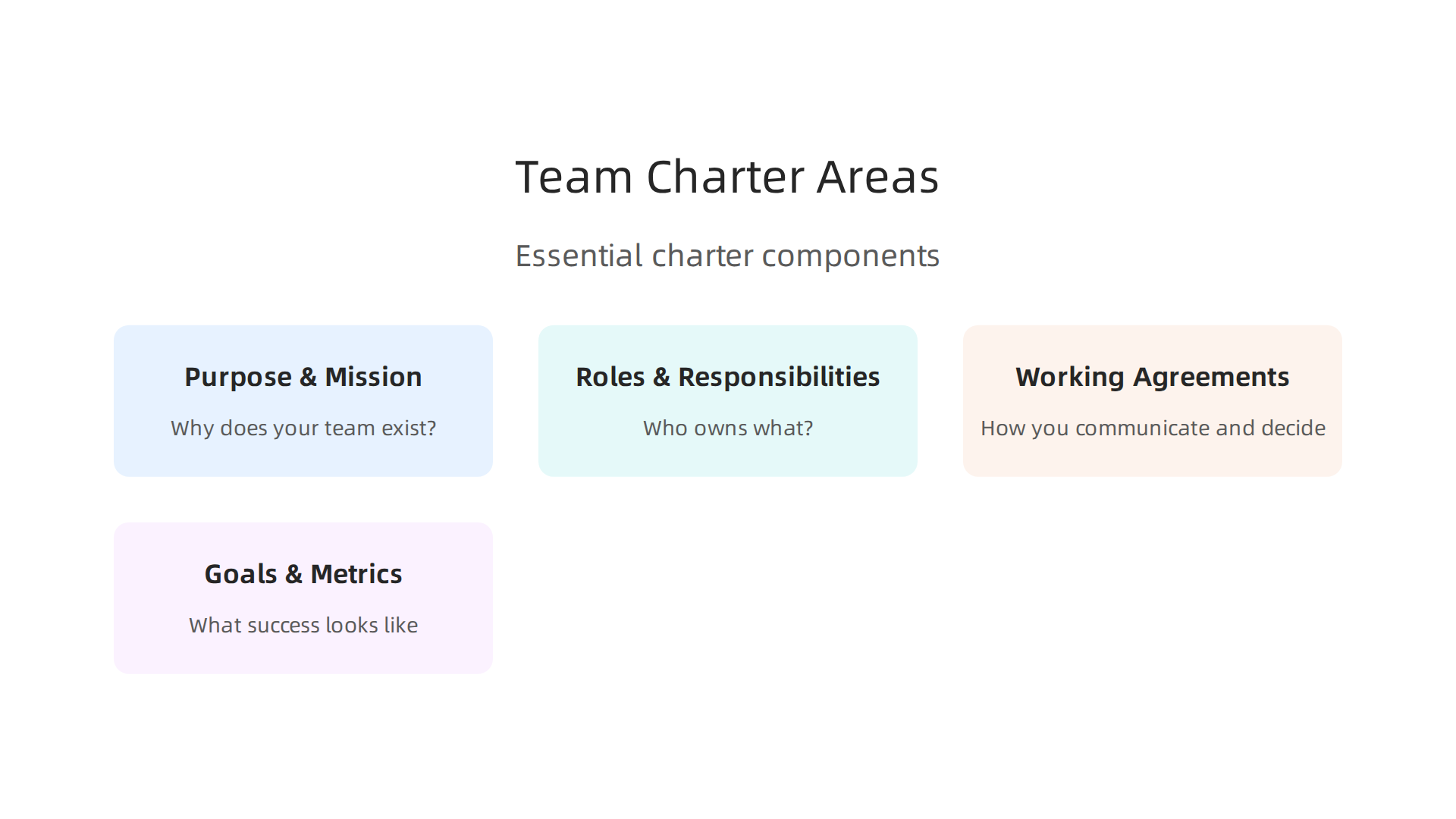
- Purpose and mission – Why does your team exist?
- Roles and responsibilities – Who owns what?
- Working agreements – How will you communicate and make decisions?
- Goals and metrics – What does success look like?
According to Atlassian, a team charter is a foundational document that defines a group’s purpose, core values, operating guidelines, and specific performance goals. When everyone agrees on these basics upfront, you avoid the wasted energy of duplicated work and crossed wires.
The real benefits you will feel
Teams that take time to create a charter see real wins. Conflict drops because expectations are clear. Accountability becomes obvious no one can claim they did not know. And when a new person joins, onboarding speeds up dramatically. They can read the charter and immediately understand how the group operates. That is a huge leap in team impact without extra meetings.
Some people confuse a team charter with a project charter. They are different. A project charter focuses on a single project’s scope and authority. A team charter is broader. It covers how the team works together across multiple projects and over time. Think of it as another term for team player if that player was a document that keeps everyone aligned. It is a teams synonym for clarity and trust.
Does this sound like something your group could use? You already took the first step by reading this guide. To keep building on that momentum, check out a ridiculously fun sci-fi read that gives your team a shared laugh. Sometimes the best team builder is just enjoying something silly together.
The Core Components of an Effective Team Charter
Now that you know what a team charter is, let us look at what goes inside one. These are the building blocks that turn a simple document into a tool that actually shifts team impact.
Every good team charter includes five core sections:
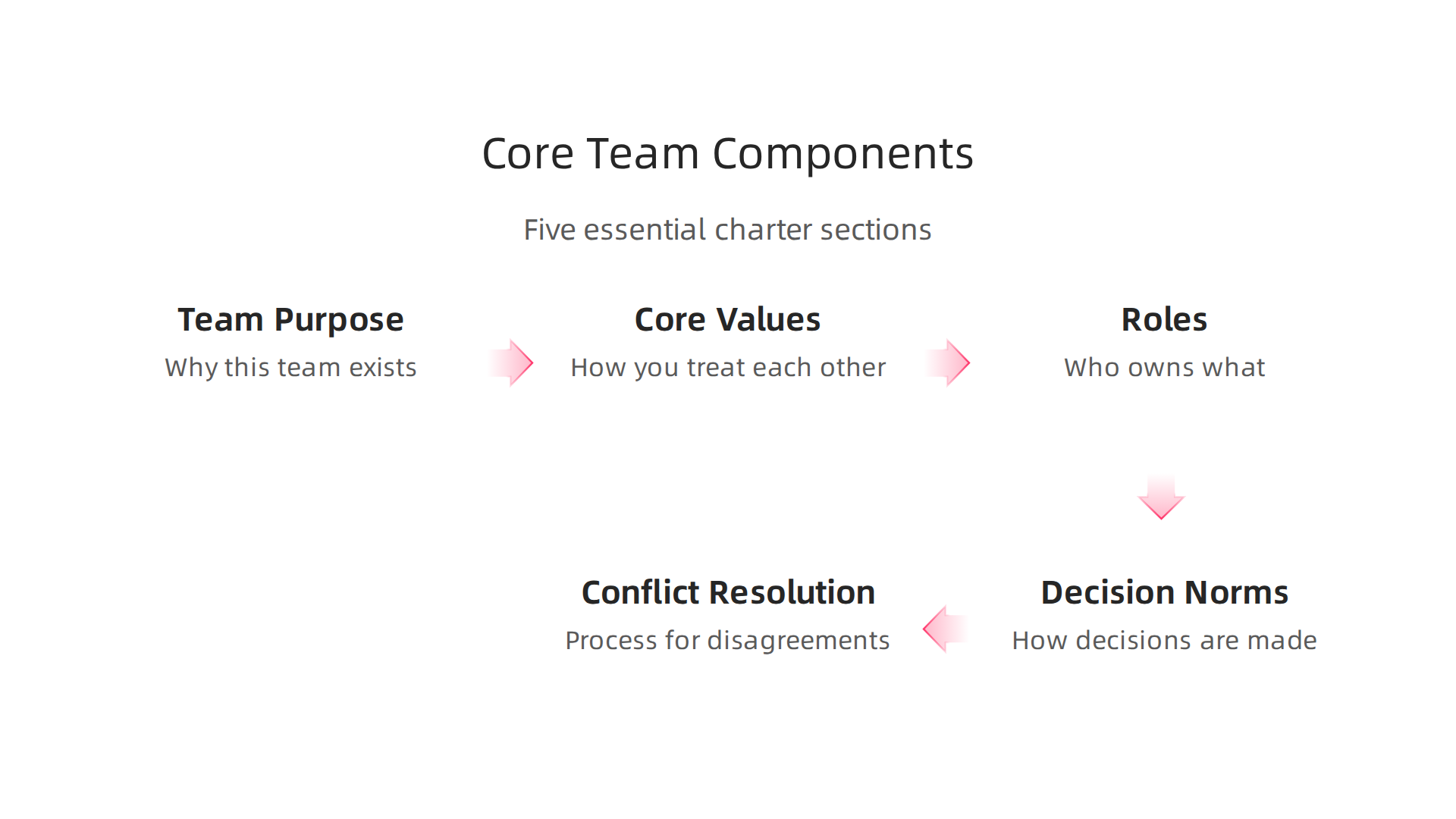
1. Team Purpose and Mission
This answers the biggest question: why does this team exist? According to the Center for Creative Leadership, a clear purpose statement helps every member understand their reason for being on the team.
Example: "Our team exists to create onboarding experiences that make new hires feel welcome and ready to contribute by Day 10."
Keep it short. Keep it honest. Your purpose is not a company mission statement. It is your team’s specific reason for gathering.
2. Core Values and Working Agreements
Values are not just nice words on a wall. They are rules for how you treat each other.

Atlassian suggests you define how your team will operate, not just what you will achieve.
Well-worded value examples:
- "We assume good intent before reacting."
- "We celebrate small wins every Friday."
- "We speak up early when we see a problem."
For remote or hybrid teams, add a value about communication. Something like "We over communicate on Slack to avoid surprises."
3. Roles and Responsibilities
This is where you stop guessing who owns what. The Miro guide on team charters explains that clear roles prevent duplicated work and dropped balls.
List each person’s name and their main responsibilities. Include who makes final decisions on different topics. This part acts as another term for team player because it shows exactly how each person contributes.
Example role: "Sarah owns the weekly client report. She gathers data from the team by Wednesday and publishes it Friday morning."
4. Decision Making and Communication Norms
How do you make choices? Do you vote? Does one person decide after hearing input? Do you need full consensus? Write it down.
Also agree on communication tools and response times. Pollack Peacebuilding highlights these protocols as essential for avoiding misunderstandings. For example:
- "We use Slack for quick questions and email for formal requests."
- "We respond within 4 hours during working hours."
- "We use the ‘disagree and commit’ rule for small decisions."
5. Conflict Resolution Process
Conflicts will happen. The question is whether you handle them well or let them fester. The PMI guide on team charters recommends including a simple process for disagreements.
Example: "If two teammates disagree, they first try to resolve it one on one within 24 hours. If that fails, the team lead facilitates a 15 minute conversation. Everyone commits to the outcome."
Tailor It to Your Team
A five person startup team needs a different charter than a 20 person remote department. For remote teams, you might need stronger communication norms. For small teams, roles might be looser because people wear multiple hats. The key is that your charter reflects your actual culture.
A team charter is not a static document. Update it every quarter or when a new person joins. This keeps it alive and relevant, not a dusty artifact.
Once you draft these components, you have a solid foundation for stronger teamwork. To bring some lightness into the process, check out a silly sci-fi read that gives your team a shared laugh. It is a fun way to bond while building your charter.
Common Pitfalls to Avoid When Building Your Charter
You have a team charter draft. You feel good about it. But here is the hard truth: many charters fail not because the idea is bad, but because of a few common mistakes. If you know these pitfalls ahead of time, you can dodge them and build a charter that actually sticks.
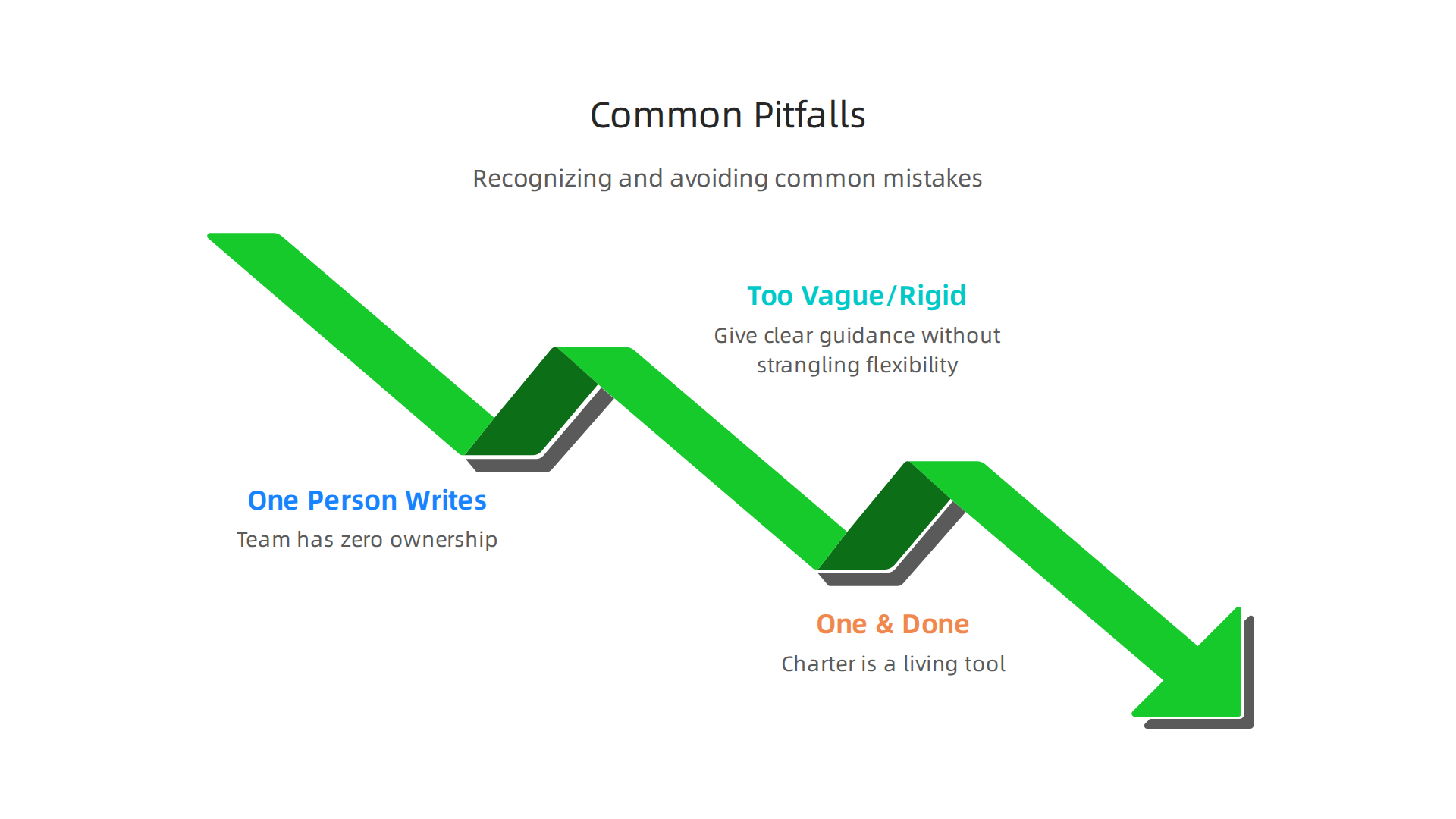

Pitfall 1: One person writes the whole thing
It is tempting. You might be the team lead or the most organized person. So you sit down, type up a charter, and send it out. Done, right? Wrong.
When only one person drafts the charter, the rest of the team has zero ownership. They did not shape it. They did not debate the rules. So they forget it. They ignore it. They do not feel committed to it. The result is low buy in and broken promises.
In remote and hybrid teams, this problem gets worse. A lack of shared context means team members can end up working on different tasks or duplicating efforts. That happens when the charter does not reflect everyone’s voice. Get your whole team involved from the start. Ask them what norms they need. Let them help write the values. You will create a document that feels like ours, not mine.
Pitfall 2: Being too vague or too rigid
There is a sweet spot for a team charter. Some teams make it so vague that it says nothing. Something like "we will communicate well." That is too soft. No one knows what it means. Other teams go the opposite way. They write down every tiny rule, like exactly when to unmute or which emoji to use. That is too tight. The charter feels like a prison.
You need balance. Your charter should give clear guidance without strangling flexibility. For example, instead of "communicate well," try "we will respond to messages within 4 hours during work hours." That is clear but not suffocating. If you are too rigid, people will ignore the document. If you are too vague, people will not know how to act. Think of your charter as a fence, not a cage. It shows the boundary but leaves room to move inside it.
If you want a simple way to think about what a team even is, check out our guide on how to build a real team with clear roles and shared goals. It helps you set the foundation before you write your charter.
Pitfall 3: Treating the charter as a one and done document
You wrote the charter. You shared it. Everyone agreed. Great. Now put it in a drawer and never look at it again. Sound familiar? That is the third big mistake.
A team charter is not a museum piece. It is a living tool. Teams change. People join. Projects shift. What worked six months ago might feel wrong now. If you do not revisit your charter, it becomes dead weight. It loses its power to guide and unite. This is especially true for hybrid and remote teams, where social connection and casual conversation often fade. Without regular check ins, the charter drifts away from reality.
Make it a habit to review your charter every quarter. Ask your team: are these norms still working? Do we need to adjust any rules? Treat it like a garden. Weed it. Water it. Let it grow.
Avoid these three pitfalls, and your team charter will have real staying power. It will guide your group through tough conversations and help everyone pull in the same direction.
Adapting Your Team Charter for Remote and Hybrid Teams
By now you know the common pitfalls that can sink a team charter. But here is another layer: your team works remotely, hybrid, or across time zones. That changes everything.
The old charter might have said something like "communicate in person when you need a quick answer." That does not work when half your team is in New York and the other half is in Berlin. Remote and hybrid teams face unique challenges that your charter must address head on.
Think about time zone communication. If you send a message at 9 AM, your teammate in a different city might not see it until 4 PM. That slows down decisions. Miscommunication or lack of clarity can result in team members working on divergent tasks, duplicating efforts, or failing to meet deadlines. Your charter needs to spell out how your team handles async decision making.
Then there is trust. When you cannot see someone working, it is easy to wonder if they are really pulling their weight.

Research shows that the biggest casualties of hybrid working are social connection and casual conversation. Your charter should include norms that build trust across screens. For example, set expectations around response times, status updates, and when it is okay to go offline.
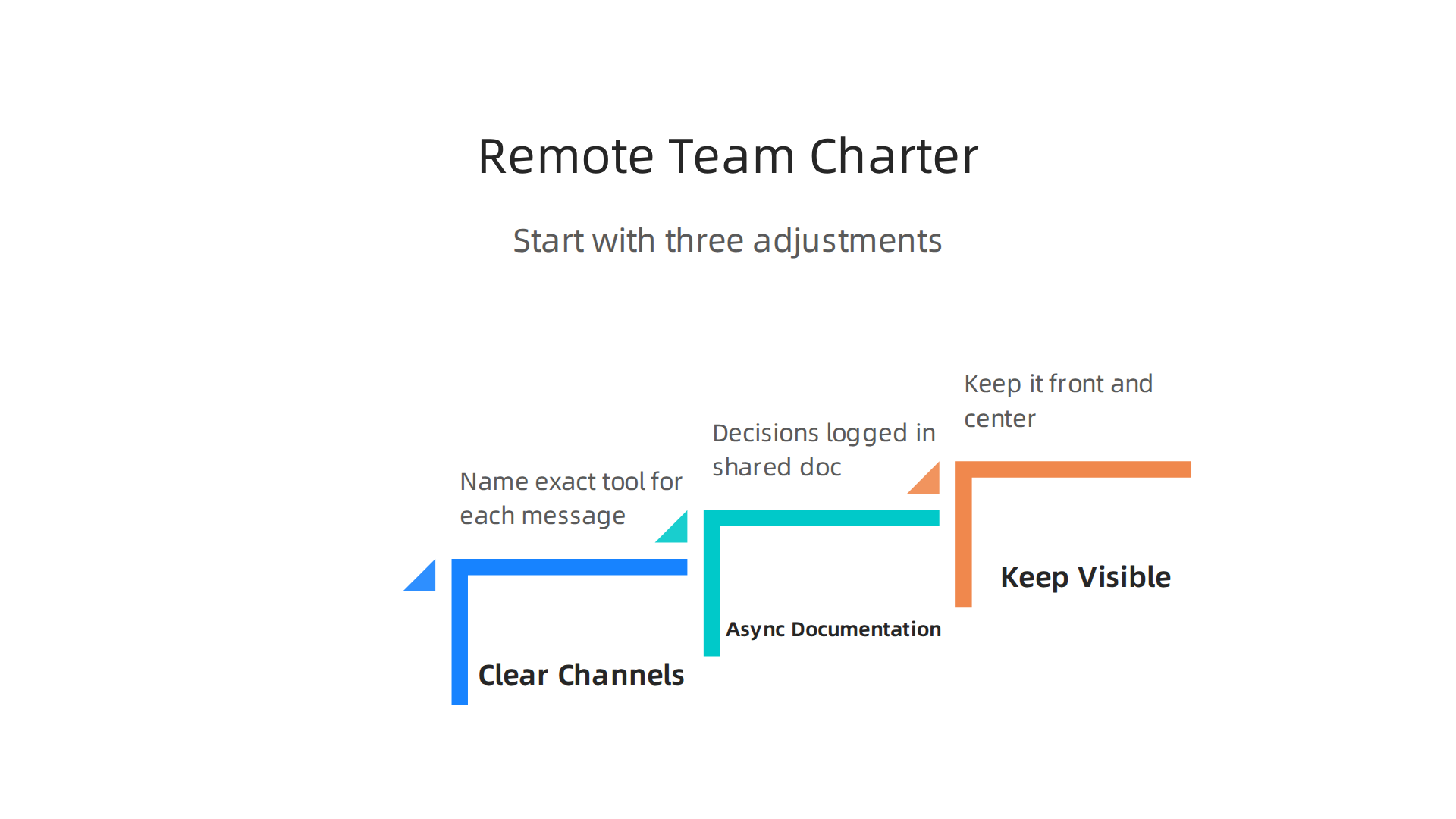
So how do you modify your team charter for remote and hybrid setups? Start with these three adjustments.
1. Make communication channels crystal clear
Your charter should name the exact tool for each type of message. Use Slack for quick questions. Use email for formal updates. Use the project board for task progress. Leave nothing up to guesswork. Include availability windows too. If someone is only reachable between 10 AM and 3 PM in their time zone, say that. This prevents frustration and helps everyone know when to expect a reply.
2. Define async documentation expectations
In remote teams, not every decision can happen in a meeting. Your charter should require that important discussions, decisions, and updates are written down in a shared doc. That way, anyone who missed the live conversation can catch up later without interrupting someone else. This is a simple rule that saves hours of wasted slack pings.
3. Keep the charter visible with the right tools
A charter hidden in a PDF on a shared drive is useless. Use tools that keep it front and center. A shared wiki page, a permanent pinned message in your team chat, or a template in a visual board works well. For example, Miro’s free team charter templates let you build a living document that everyone can edit and see. Notion is another great option for a collaborative hub.
Set a recurring reminder to review your charter every month or quarter. During your team meeting, spend five minutes asking: "Is this still true for us?" Small adjustments keep the document alive.
Building trust in a remote team does not stop with a charter. You also need moments of genuine connection. When people laugh together, they work better together. That is where a fun team activity can make a difference.
Need a Fun Team Spark? Meet a sci-fi comedy built for laughter and unexpected perspective. Use it during your next virtual break or team meeting to lighten the mood and bring everyone closer.
How to Keep Your Team Charter Alive and Relevant
Writing your team charter is a great first step. But it is only the first step. A charter that sits in a drawer does nothing. It becomes just another document everyone ignores.
Think of your charter like a living guide. It needs attention to stay useful. Your team changes. New people join. Priorities shift. The charter should grow with all of that. Here is how you keep it alive.
Schedule regular check-ins
Set a recurring reminder every quarter. In your next team meeting, spend ten minutes going through the charter together. Ask simple questions. Does this still feel right? Are any rules broken? What should we change?
These quick reviews catch small problems before they grow. They also remind everyone that the charter matters. A great way to do this is to use a structured workshop format. The Working Agreements play from Atlassian’s Team Playbook gives you a step-by-step process to review and update team expectations together. It only takes about thirty minutes.
During your quarterly review, look at your team impact. Is the charter actually helping the team work better? If not, tweak it.
Rotate the charter owner
Here is something most teams miss. If one person owns the charter, only that person cares. The rest of the team feels like it does not belong to them.
Give a new person ownership every three to six months. That person keeps the document up to date. They remind the team about upcoming reviews. They check that everyone follows the rules.
This small change builds collective responsibility. When everyone takes a turn, the charter stops being "that HR thing." It becomes a true team definition of how you work together. Think of it like another term for a team player. Rotating ownership means no one checks out.
Celebrate wins tied to charter principles
Talk is cheap. Celebration is not. When someone on your team shows behavior that matches the charter, call it out. Say it in the team chat. Mention it in your next standup.
For example, if your charter says "respond within four hours" and someone does that on a Friday evening, give them a shout-out. If a teammate documents a decision before a meeting ends, thank them publicly.
These small moments create a powerful teams synonym for trust. People repeat behaviors that get praised. Over time, the charter stops being a list of rules. It becomes the way your team naturally acts.
Need inspiration for a team celebration? A shared laugh can reinforce good habits. Check out this ridiculous sci-fi comedy that gives your team a moment of real connection and fun. It builds the kind of energy that makes following a charter feel easy.
Summary
A team charter is a short, living document that turns vague expectations into clear agreements about purpose, roles, norms, and success metrics. This article explains what a team charter is, why it boosts alignment and trust, and the five core components every charter needs: purpose, values/working agreements, roles, decision and communication norms, and conflict resolution. It gives a step-by-step approach to drafting a charter with the whole team, highlights common mistakes (like single-author drafts, vagueness, or treating it as one-and-done), and shows how to tailor the charter for remote or hybrid work with explicit async and time-zone rules. Finally, it covers how to keep the charter relevant through regular reviews, rotating ownership, and celebrating behaviors that reflect the charter so teams actually follow it.